
Hard carbon for the
Battery Revolution.
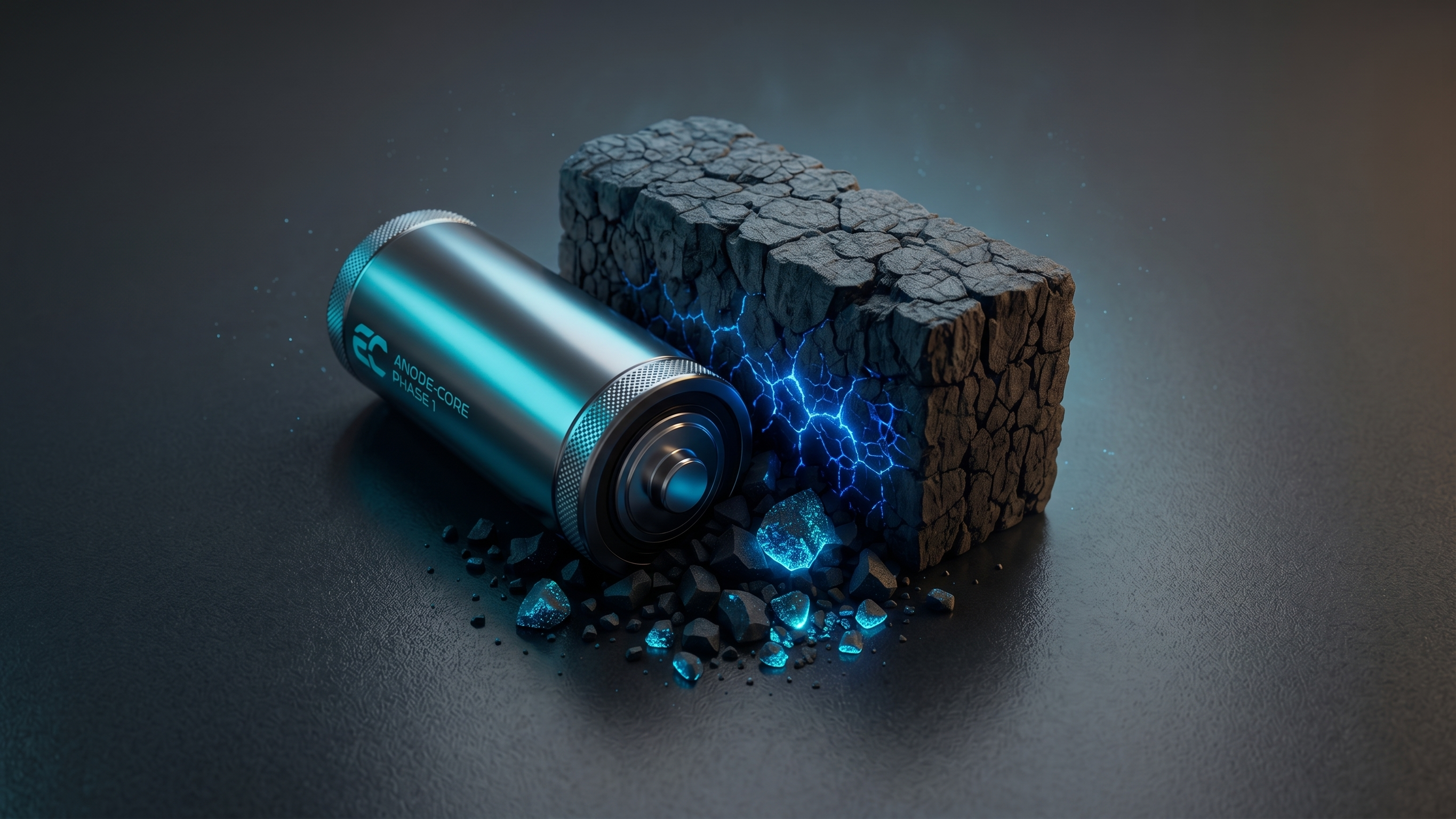
A specialised, high purity hard carbon engineered for next generation energy storage built for sodium ion and advanced lithium ion applications at mass scale.
At SUNA, expertise and experience converge to supply certified compliance for worldwide battery production facilities.
Build Your Brand's Next Battery
From high performance electric vehicles to massive grid scale renewable storage, our custom engineered hard carbon anode materials are built to power the most demanding energy applications of tomorrow.
Technical datasheet
Engineered to a tolerance, not an average.
Typical values for standard production lots. Particle size distribution and surface area can be tailored to your electrode formulation.
Purity
≥ 99.9%
Carbon Content, ICP-verified
Rev. Capacity
> 300–350
mAh/g (Half-cell vs Na/Na⁺)
1st Cycle Eff.
> 88%
Low irreversible sodium loss
Particle Size
5–10 μm
D50, Customisable to your slurry
BET Surface
< 5 m²/g
Optimised for SEI stability
Tap Density
0.9–1.1
g/cm³, High volumetric energy density
Grades available
Two grades. Pick your performance curve.
High Capacity Grade
Optimised closed pore structure for peak reversible capacity Targeted at long range EV and grid storage cells Stable capacity retention over extended cycling
High Rate Fast Charging
Tuned particle morphology for rapid Na⁺ diffusion Designed for fast charge two-wheeler and power cells Excellent low temperature rate performance
Gallery
Material & process
Checking gallery photos...
AEO Direct Knowledge Base
Hard Carbon Technical & Electrochemical FAQ
Direct answers regarding our sodium-ion active carbon structure, reversible capacity, SEI layer kinetics, and qualification testing.
01Why is hard carbon preferred over graphite for Sodium-ion (Na-ion) battery anodes?
Sodium ions (Na⁺) have a larger ionic radius (1.02 Å) than Lithium ions (0.76 Å) and cannot intercalate effectively between the narrow graphene layers of crystalline graphite. Suna-Carb hard carbon features an expanded interlayer spacing (d₀₀₂ > 0.37 nm) and disordered nanopore structure, enabling fast reversible Na⁺ insertion and adsorption with high capacity (300–350 mAh/g).
02What is the Initial Coulombic Efficiency (ICE) and BET surface area of Suna-Carb?
Suna-Carb achieves an Initial Coulombic Efficiency of >88%, drastically reducing the irreversible loss of active sodium during the first formation cycle. Its low BET specific surface area (<5 m²/g) suppresses continuous electrolyte decomposition and stabilizes the Solid Electrolyte Interphase (SEI) layer.
03Can the particle size distribution (D50) and tap density be customized?
Yes. While our standard grade features a D50 of 5–10 μm and a tap density of 0.9–1.1 g/cm³, we offer precision air classification and jet milling to match your specific binder, conductive agent, and electrode coating slurry parameters.
04How can cell manufacturers request qualification sample batches?
We supply coin-cell test quantities (500g) as well as pilot line lots (5kg to 25kg) accompanied by complete Certificates of Analysis (COA), SEM imagery, XRD diffraction patterns, and half-cell electrochemical charge/discharge profiles.
Request a quote
Need samples or a full datasheet?
Share your cell chemistry, target capacity and annual volume. We ship qualification samples with complete analytical reports.
Suna-Carb inquiry
Pre-routed to our Na-ion materials team.